Several Parts in One Request, Your Own Search Allowance, and a Verified Bot
In July we wrote that a part request should name exactly one part, and hank would tell you off if it named more. That advice made sense for the search. It made no sense for the deal.
Someone rebuilding a front end needs a hood, two fenders, a bumper and both headlights. Split into six requests, that is six conversations with the same breaker, six offers and six shipments for what is really one pickup. So we rebuilt it: one request, several parts, a separate search for each of them.
Here is everything that is new.
Several Parts, One Request
Name more than one part in your description and hank no longer refuses to search it. Instead, it splits the search: every part gets its own automated web search and its own report, while the request itself stays a single request in the marketplace.
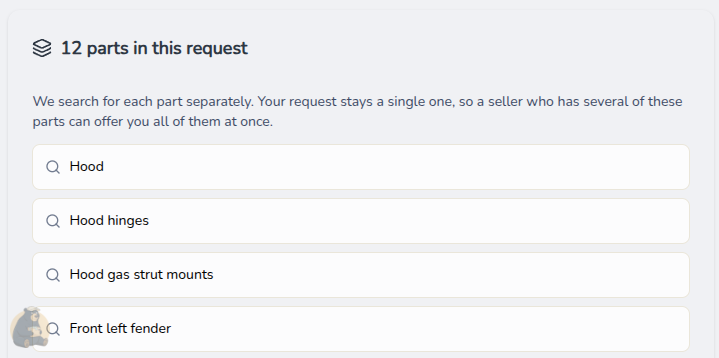
That last bit is the point. A seller who happens to have four of the six parts you need sees one request and can offer you all four in one go, instead of meeting you in four separate chats.
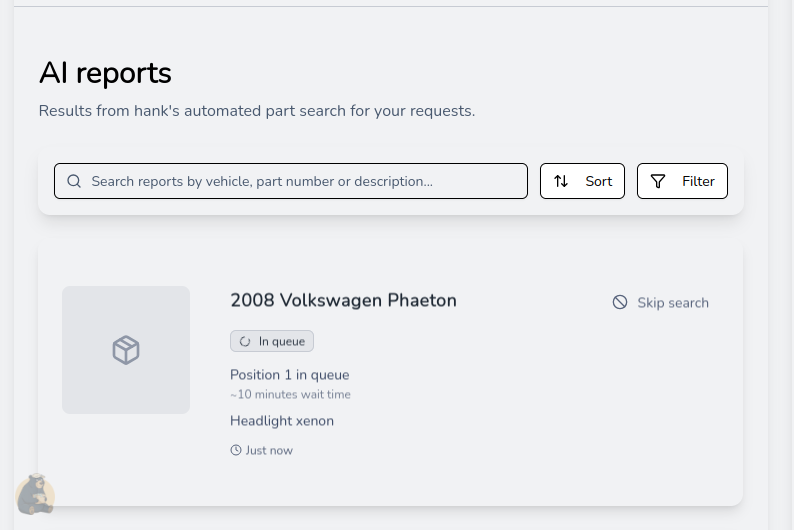
The status page tells you how many parts hank found in your description. Your AI reports page shows how many searches are still running, and each part's report lands on its own as soon as it is done. If one part comes back empty, the others still deliver.
Your AI Search Allowance
Automated searches cost us real money, so they cannot be unlimited. Now that a single request can trigger a dozen of them, there is a budget - and, more importantly, you can see it.
Your AI reports page now has an AI searches left panel. Collapsed by default, because the number only matters when something is waiting on it.
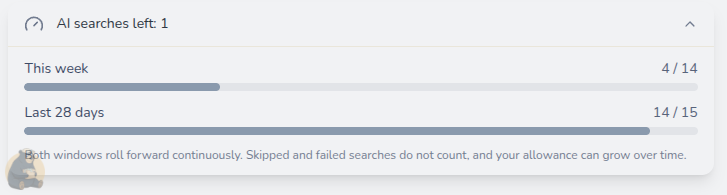
Open it and you see both windows it is counted in: this week and the last 28 days. Both roll forward continuously, so nothing resets at midnight on the first of the month and leaves you stuck for three weeks.
Two things worth knowing:
- Skipped and failed searches do not count. If you stop a search before it runs, or something goes wrong on our side, you keep the allowance.
- Your allowance can grow over time. The panel always shows the number that currently applies to you.
Nothing Starts Behind Your Back
A request with six parts needs six searches. If you only have four left, hank does not quietly search for four of them and drop the rest. The request waits, and you decide.
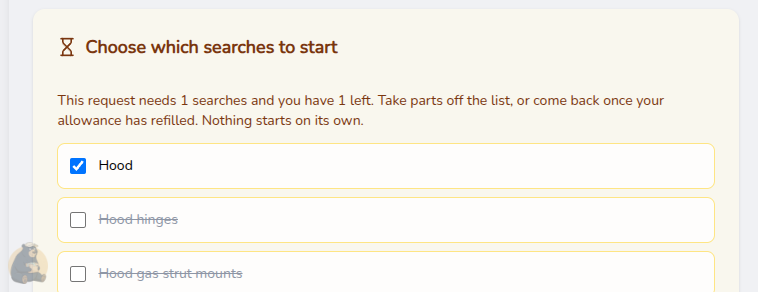
Take parts off the list until it fits, start the searches you care about most, or come back when your allowance has refilled. Either way, your request is live on hank the entire time and sellers can send you offers regardless. The allowance only governs the automated web search.
Part Numbers Get Checked, and You Can Watch It Happen
A wrong part number is a search for nothing. hank now checks the number the moment you file the request and tells you where it stands: checking, checked, or what exactly is wrong with it. It usually takes seconds.
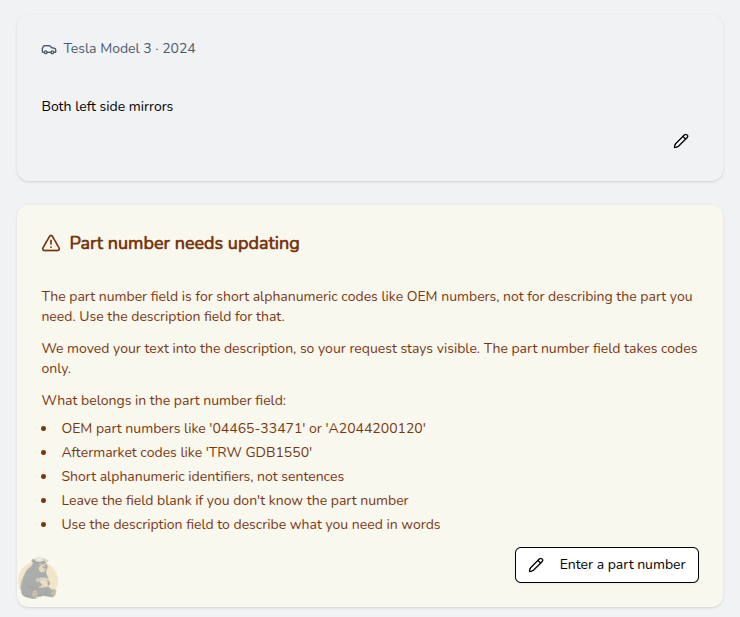
The most common mistake was not a typo. People described the part in the part number field: "front left headlight for my Golf" instead of a code. Previously that stalled the request with no obvious way out. Now hank shows you exactly what you entered and offers a Move to description button: one click puts the text where it belongs. If your request had no description at all, hank moves the text across by itself. Either way your request stays visible the whole time, and the part number field goes back to waiting for a code, or for nothing at all if you do not have one.
And if your description never names an actual part, you get asked directly instead of waiting for a search that has nothing to look for.
Share a Request, Get a Real Preview
Paste a part request link into WhatsApp, Slack or a forum and it now unfolds into a proper preview card naming the vehicle, with your part photo on it if you uploaded one, instead of a bare URL.
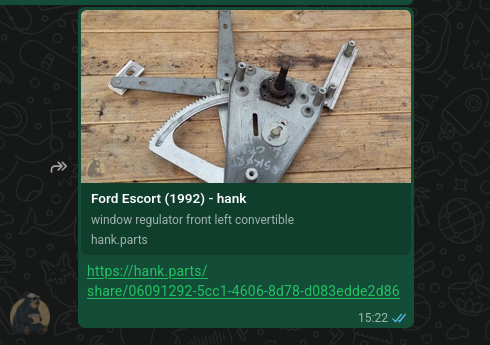
Handy when the person helping with your repair is in a group chat rather than on hank.
hank's Crawler Is a Verified Bot Now
This one is invisible in the interface and matters a lot anyway.
When hank searches shops for your part, our crawler identifies itself as hankbot, signs every single request cryptographically, and follows each shop's robots.txt. No pretending to be a browser. Cloudflare has now granted hankbot verified bot status, which means shops using Cloudflare can recognise us for what we are.
The effect was immediate and large: anti-bot challenges on the pages we read fell from roughly a quarter of all fetches to under two percent, so hank gets to read shops it used to bounce off. For shops it means hank is identifiable and blockable by choice, which is how a crawler should behave. Details live at hank.parts/hankbot.
Smaller Things
- Rotate images before uploading: photographed the part sideways? Turn it upright in the upload dialog, no photo app detour.
- hank team members are marked: anyone from the hank team now carries a badge in their profile and in the chat header, so you can tell an official message from a stranger's.
- Login errors that actually say something: sign in with a provider that clashes with an account you already have and you now get told so, instead of watching the form fail silently. Signing in with Google could also fail with a vague technical error; that is fixed.
- Sharper prices: where a shop publishes structured product data, hank reads the price out of it instead of interpreting the page. The rest of the page goes through a deterministic scan that handles the net-versus-gross traps, including the ones where both numbers sit on the same line. And prices wildly out of line with what a part normally costs no longer skew the price ranges on our part pages.
- Ten new part categories: cylinder head, crankcase, turbocharger, transmission, clutch, axle shaft, AC compressor, carburetor, catalytic converter and instrument cluster now have their own pages with model-specific buying advice, wherever they apply - no turbo page for a naturally aspirated car, no carburetor page for anything built well after the injectors arrived.
Happy hanking!
Robert - hank team